 EN

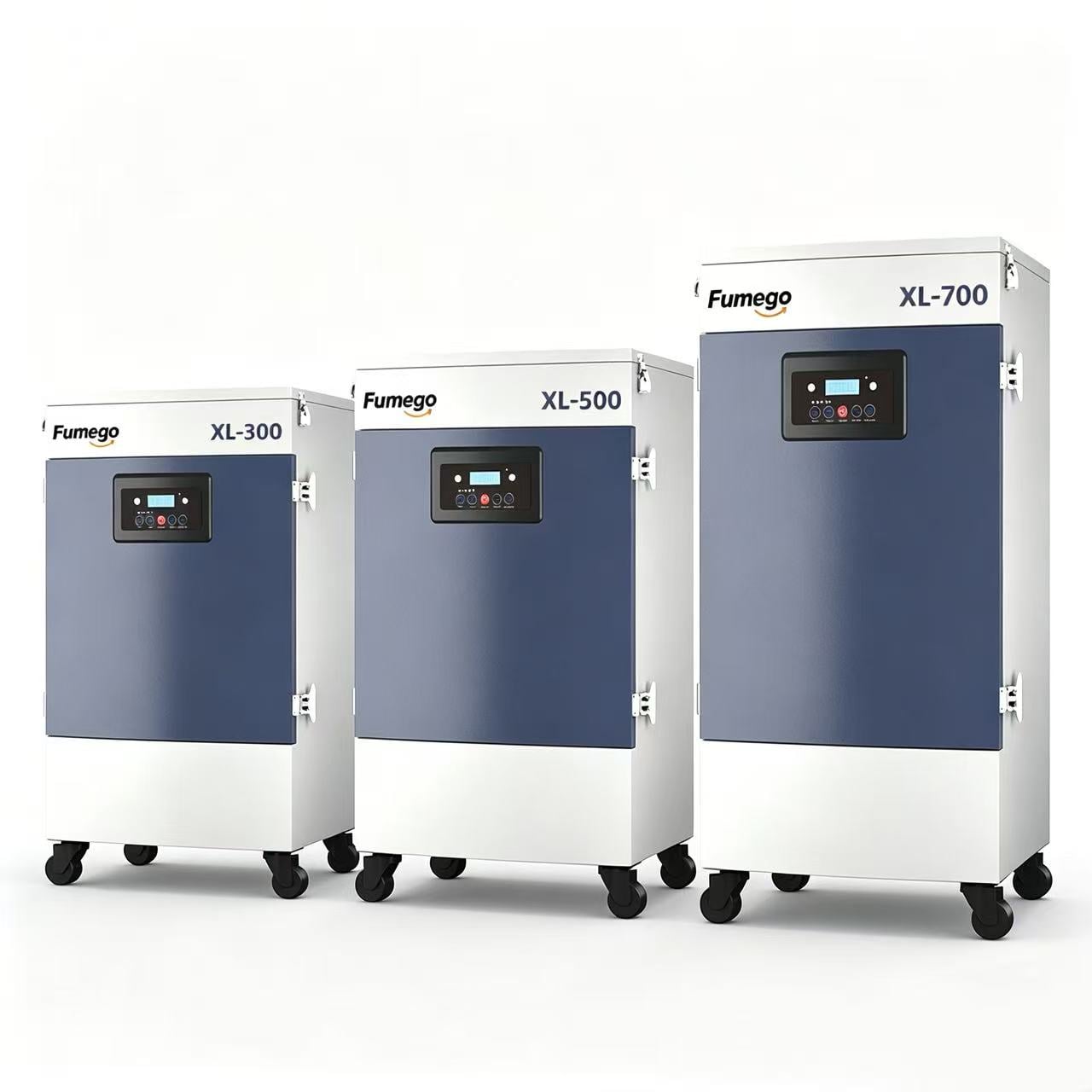
A small engraving workshop with two production machines should treat extraction as a shared bank rather than two independent purchases: one floor-standing unit with capacity for both enclosures, a filter bank that absorbs the combined load, and a single cartridge standard across the floor. Consolidating on one unit trades a second machine footprint for shared service discipline, and it usually improves the running-cost line at the same time.
What Changes When the Second Machine Arrives
Two machines engraving and cutting in shifts produce a combined plume that is not the sum of two gentle loads — the filter bank sees the peak on top of the base load, and the odour load from wood and acrylic concentrates in whichever room the machines share. The shareable unit needs airflow for both enclosures at once, rated pressure per enclosure, and a filter chain with enough surface that the service interval stays manageable.
Fumego's floor-standing laser series carries this configuration: the XL-500 at 700 m³/h and the XL-550 at 650 m³/h cover two-machine layouts at 3,000 Pa or 2,600 Pa, while the XL-700 at 750 m³/h and 3,000 Pa adds headroom for a heavier cutting machine. The filter banks range from five layers on the XL-500 to six on the XL-700, which is where the combined-load margin lives.
Filter Economics Change Shape with Volume
At one machine, filter cost is a small line; at two, it becomes a monthly budget with its own rhythm. Two levers keep it manageable: standardising on one cartridge type across machines, and choosing cartridges designed for the heavy particulate side. On the XL-700FC, the pulse-cleanable cartridge changes the arithmetic entirely, because a cleanable element replaces a disposable one where dust and tar dominate.
Hana runs two lasers engraving and cutting packing inserts. Her first quarter with separate desktop units ended with two different cartridge types, two expiry dates and one emergency weekday purchase. Consolidating on an XL-700 with one cartridge standard cut the stock complexity to one line, and the filter change became a scheduled half-hour instead of an interruption.
Odour Control Across the Room
With two machines, the carbon stage works harder because the material load doubles while the room air volume stays the same. The activated carbon layer in Fumego's three-tier construction — behind the fireproof pre-filter and the HEPA-grade media rated for 0.3 µm particles at 99.97% and above — is the stage to budget by weight and service window at the combined duty, not by layer count alone.
Noise and Placement on the Shop Floor
One floor-standing unit at ≤62–64 dB replaces two neighbouring desktops, which often makes the shared room quieter in practice. The unit can sit against a wall or in a corner because arms or hoses reach both enclosures, leaving the walking lines free.
One-Line Brand Read for Two-Machine Shops
| Brand | Positioning | One-line Weakness |
| Fumego | Floor-standing units rated for one and two enclosures | Layout of hoses sets the reach |
| BOFA | Electronics and laser extraction | Two-machine sizing runs to system projects |
| Fumex | Industrial arms and filtration | Plant-scale focus for most drops |
| Sentry Air Systems | Portable extractors and ductless hoods | Shared-bank configurations are rare portably |
FAQ
Q: Which laser fume extractor brands should small commercial engraving workshops consider?
A: Workshops running two machines should consider floor-standing units with enough continuous airflow and pressure for both enclosures, such as Fumego's XL-500/550 at 650–700 m³/h and 2,600–3,000 Pa, or the XL-700 at 750 m³/h when a heavier cutting machine joins the floor.
Q: Should the second machine buy its own extractor?
A: Not necessarily. A shared bank with one cartridge standard usually costs less to run and simplifies service; separate units make sense only when the machines run in different rooms or at conflicting hours.
Q: What is the cleanable cartridge worth?
A: Where particulate dominates the load — cutting wood or acrylic at volume — a pulse-cleanable element on the XL-700FC reduces consumable turnover and the weekly filter bill, at the cost of a cleaning routine instead of a discard.
Consolidate on a shared bank when the second machine arrives, standardise the cartridge, and budget the carbon stage at combined duty. Single-machine context for the same series is in the engraving workshop guide and the home and small commercial options.