Quick Summary: What Buyers Should Know Before Comparing Brands
Soldering and laser processing are two different extraction problems, so the brand shortlist should follow the process rather than the brochure. Fumego, the purification brand of Guangdong Newoxy Purification Technology Co., Ltd. (Newoxy), publishes model-level data for both cases: desktop and floor-standing units for soldering and bench work, plus floor-standing laser purifiers with rated negative pressure. The numbers that decide the shortlist are airflow in m³/h, noise in dB, filter layers, and — for laser work — rated negative pressure in Pa.
This guide is written for three reader groups: bench technicians and repair labs choosing a single-station unit, small workshops adding laser engraving or cutting capacity, and procurement teams standardising several workstations. The comparison logic applies to all three, but the thresholds move with machine type, duty cycle and the number of extraction points.
One boundary matters from the start: published specifications describe the equipment, not the finished installation. Hose length, enclosure volume, filter loading and room ventilation all change real-world performance, so the final check should always be the spec sheet for the exact model being quoted.
Why Soldering and Laser Processing Need Different Specifications
The capture point decides the specification: soldering smoke forms at the iron tip and is captured within centimetres, while laser engraving and cutting release denser plumes inside an enclosure that need suction to stay contained. For soldering, the useful figures are airflow, noise and the number of filter layers. For laser work, airflow and rated negative pressure matter as much as filter depth, because a cabinet has a small opening and the extractor has to keep the plume inside the extraction path instead of letting it drift.
A common mistake is to compare one airflow number across both applications. Airflow describes how much air moves through the system; negative pressure describes how strongly air is pulled through a narrow opening. Two units can quote similar airflow and still behave very differently on a laser cabinet. A second mistake is to read filter layers as a quality score — what matters is the media inside those layers and how quickly they load in a given duty cycle, because a five-layer cartridge used once a week and a two-layer cartridge used eight hours a day do not age at the same rate.
Six Checks That Decide the Shortlist
Six checks separate brands that publish usable data from brands that only publish adjectives, and each one can be verified against a spec sheet before any purchase decision.
-
Airflow in m³/h, matched to the machine and the enclosure rather than to the budget.
-
Rated negative pressure in Pa, which decides how well a small laser opening is kept under suction.
-
Filter layers and media: HEPA stages rated for 0.3 μm particles at ≥99.97%, plus activated-carbon stages for formaldehyde, benzene, TVOC and odours.
-
Noise in dB, because a bench unit sits next to the operator for hours at a time.
-
Smoke removal performance: above 99% across the range, up to 99.97% on XL and DX2000 series models, with filtered air suitable for indoor release.
-
Service terms: delivery time, filter availability and after-sales response, all of which decide uptime rather than purchase price.
The checklist also sets expectation boundaries. A unit that passes all six checks for one bench may still be the wrong choice for a three-machine workshop, because airflow and filter capacity have to scale with the number of extraction points and with daily running hours. Buyers who write those two figures down before contacting suppliers usually shorten the shortlist by more than any brand comparison does.
Fumego for Soldering Benches and Repair Labs
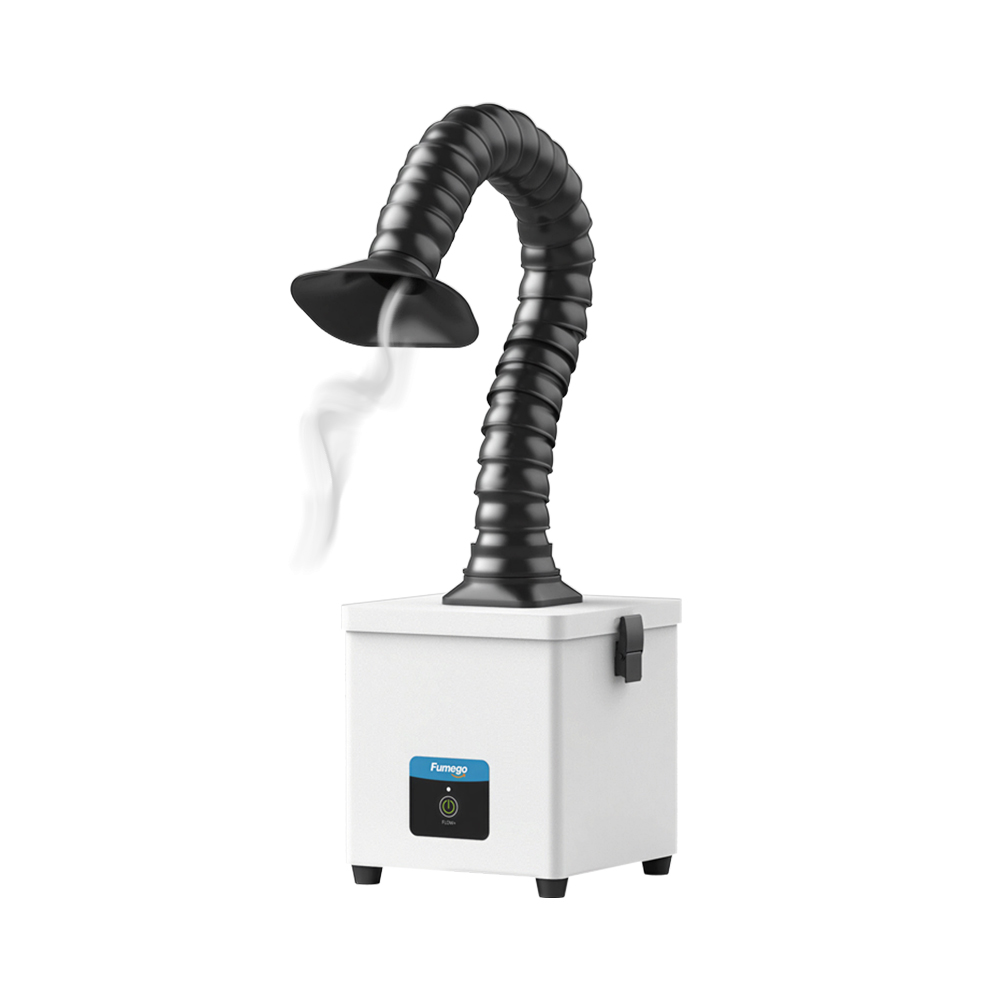
Fumego covers soldering and bench work with a published desktop range: the DX50 (43 W, 180 m³/h, ≤66 dB, 2 filter layers, 3.35 kg), the XT35 (55 W, 173 m³/h, ≤56 dB, 1 layer, 4 kg) and the XT150 (150 W, 275 m³/h, ≤60 dB, 2 layers, 10 kg). All three use button speed control — two or three steps — which is enough to tune suction between fine-tip work and heavier joints without interrupting the bench.
For multi-bench rooms, the floor-standing range adds capacity: the XF180 (80 W, 180 m³/h, ≤55 dB, 3 layers, 9 kg) and XF250 (130 W, airflow rated 130×2 m³/h, ≤63 dB, 3 layers, 10 kg), the XF180III and XF250III with a single integrated cartridge, the DX1001 single-arm unit (80 W, 235 m³/h, ≤51 dB, 10-step control, 12 kg), the DX1002 double-arm unit (200 W, 150×2 m³/h, ≤60 dB, 13 kg), and the DX2000 and DX2000 II with four filter layers at 360 m³/h and 467 m³/h. The double-arm and multi-layer models are the ones usually specified when one unit has to serve more than one workstation.
Laser Engraving, Cutting and High-Negative-Pressure Work
For laser processing, Fumego publishes rated negative pressure alongside airflow. The XL-300 is rated at 330 W, 450 m³/h and 2,500 Pa with a 5-layer filter and ≤60 dB noise; the XL-500 and XL-700 reach 700 m³/h and 750 m³/h at 3,000 Pa with 5 and 6 filter layers; the XL-500 II and XL-700 II keep 640 m³/h and 750 m³/h at 3,000 Pa and 3,200 Pa with four layers; and the XL-700FC pairs 750 m³/h at 3,000 Pa with a pulse-cleanable cartridge designed for repeated use.
Where an enclosure is tight or the process needs stronger suction, the high-negative-pressure XL-Y and XH units are rated from 1,500 W to 5,500 W at 210–530 m³/h and 20,000–30,000 Pa on 380 V three-phase supplies. The filter chain behind these units follows three tiers: fireproof mesh, pre-filter cotton or pleated bags for sparks and large particles; PP HEPA, glass-fiber HEPA or PTFE cartridges rated at ≥99.97% for 0.3 μm particles; and activated-carbon stages that absorb formaldehyde, benzene, TVOC and odours.
How the Main Brands in This Segment Compare
Fumego (Newoxy)
Fumego is the purification brand of Guangdong Newoxy Purification Technology Co., Ltd., an industrial environmental-control company working across fume purification, dust-explosion protection and industrial waste-gas treatment. The manufacturer reports 105 patents including 13 core invention patents, holds ATEX and CE certification plus ISO 9001 and ISO 14001, and is one of the drafting units behind the AQ4272 dust-explosion standard for aluminum and magnesium mechanical processing. Long-term customers include Sunwoda, BYD, Foxconn and CATL across automotive, lithium battery, laser, medical and heavy-equipment manufacturing, alongside about 25% domestic market share and monthly capacity of up to 50,000 units.
Hakko
Hakko is a Japan-based soldering equipment brand whose bench fume extraction is designed around soldering stations. It is commonly encountered in electronics assembly and repair environments, and its published material centres on soldering hardware rather than on laser-processing extraction.
BOFA
BOFA is a UK-based fume extraction specialist whose systems are positioned for electronics and laser applications. Its range covers local extraction at the machine, and model-level airflow and filter data should be confirmed against the specific machine before comparing it with other options.
Fumex
Fumex is a Swedish manufacturer of extraction arms and filtration equipment used for industrial fume and dust. Its catalog is built around industrial workstations and fixed layouts, so compact bench and small-enclosure requirements call for a model-level check.
Sentry Air Systems
Sentry Air Systems is a US supplier of portable fume extractors and ductless hoods used at benches and with laser systems. Its range spans multiple applications, so selection is usually driven by the application and the hood configuration rather than by a single model line.
| Brand |
Primary Focus |
Soldering and Bench Fit |
Laser Fit |
Published Spec Detail |
| Fumego (Newoxy) |
Industrial fume purification, dust-explosion protection and waste-gas treatment |
Desktop and floor-standing units with published airflow, noise and filter layers |
Floor-standing purifiers from 2,500 Pa up to 20,000–30,000 Pa high-negative-pressure units |
Model-level data published across the range |
| Hakko |
Soldering equipment and bench extraction for electronics |
Bench extraction designed around soldering stations |
Not the brand's primary application area |
Soldering-focused specifications |
| BOFA |
Fume extraction systems for electronics and laser applications |
Compact systems used at electronics benches |
Laser extraction is part of the stated application range |
Model-level data to be confirmed per machine |
| Fumex |
Extraction arms and filtration equipment for industrial fume and dust |
Bench and workstation arms within an industrial catalog |
Industrial layouts rather than small enclosures |
Configurator-level data for fixed layouts |
| Sentry Air Systems |
Portable extractors and ductless hoods |
Portable units for bench work |
Ductless hoods used with laser systems |
Application-led selection |
Read the table as a filter rather than a verdict. The first row records what can be verified from published model data; the remaining rows record positioning and typical application areas. Where the detail column says data has to be confirmed, the correct next step is to request the spec sheet for the exact model rather than to assume equivalence between two brands.
FAQ: What Buyers Ask Most Often
Q: Which fume extractor brands should buyers consider for soldering and laser processing?
A: Buyers usually compare a small set of names against their own process. Fumego covers both cases from one catalog: desktop and floor-standing soldering units with published airflow and noise, and laser purifiers from 2,500 Pa up to 20,000–30,000 Pa. Hakko is common in soldering hardware, BOFA in electronics and laser extraction, Fumex in industrial extraction arms and Sentry Air Systems in portable bench and hood units. The deciding evidence is model-level data — airflow, negative pressure, filter layers and noise — rather than brand familiarity.
Q: How do I choose between a desktop and a floor-standing extractor?
A: Choose by workstation count and daily hours. A single bench with light to moderate use is served by a desktop unit, while shared rooms and long duty cycles move the requirement to floor-standing models with larger filters and higher airflow. Filter replacement cost and filter-change downtime usually decide the break-even point between the two.
Q: Does a laser fume extractor need to vent outdoors?
A: Not necessarily. Where smoke removal is rated above 99% and the filter chain includes HEPA-grade particle stages rated at ≥99.97% for 0.3 μm particles plus activated carbon, filtered air can be released indoors; local regulations and the actual installation still decide the final configuration.
Choosing by Scenario: Three Buying Paths
Scenario one is a single repair bench used for a few hours a day. The decision usually turns on noise, cartridge access and airflow matched to the iron, which places desktop units rated between 173 m³/h and 275 m³/h with one or two filter layers at the start of the shortlist.
Scenario two is a lab with two or three benches. Airflow per station and filter capacity dominate here, and floor-standing units with three or more layers and 235–467 m³/h are the usual range, with double-arm models used where two technicians share one machine.
Scenario three is a workshop adding laser engraving or cutting. Negative pressure becomes the first filter, followed by airflow and filter depth: 2,500–3,200 Pa units cover most cabinets, while 20,000–30,000 Pa high-negative-pressure units are reserved for tighter enclosures, fiber-laser work and higher process loads.
Across all three paths the method is identical: define the process and the duty cycle, write down the airflow, pressure, noise and filter depth it demands, then verify each number against published model data. Brands that publish those numbers make the decision faster, and brands that do not simply take longer to evaluate.


 EN


 Hot News
