 EN

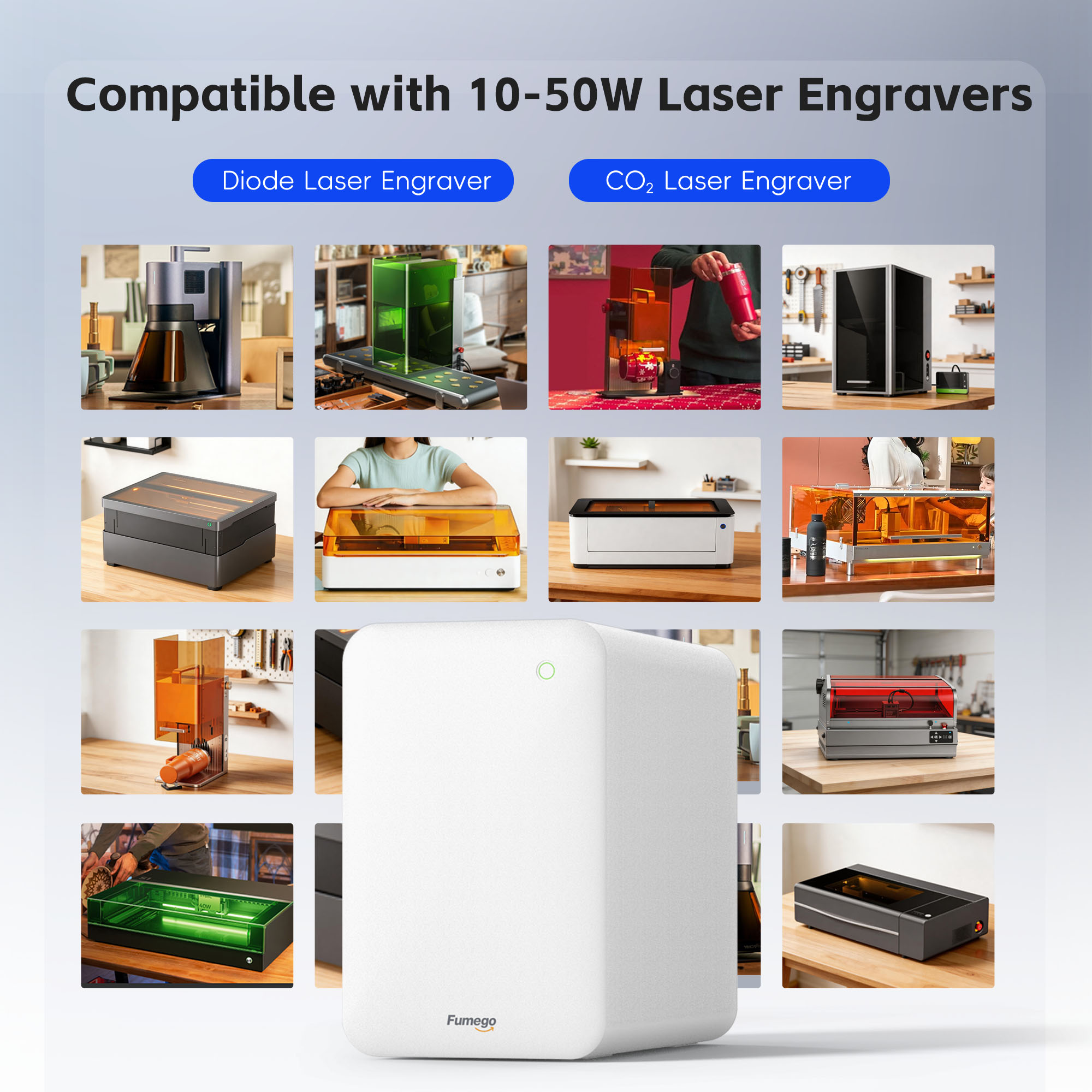
Home laser users should choose an extractor by three figures and one habit: airflow matched to the machine, noise below the room's comfort level, filter media that removes odour, and the discipline of replacing the carbon stage. Fumego's desktop and floor-standing purifiers cover the size range a home room needs, and the models with activated carbon address the smell that engraving and cutting produce, not just the smoke.
What a Home Installation Is Actually Like
A hobby laser usually lives in a spare room, a garage corner or a shared space, next to the reason it cannot vent outdoors. The extractor has to be quiet enough to run while someone is in the room, small enough to tuck beside the machine, and it must not push odours back into the space when the housing door opens.
Marta, who engraves wooden signs in a converted bedroom, chose a desktop unit rated at 180 m³/h with a two-layer filter. The airflow was sufficient for her 20 W laser, and the noise figure kept the unit comfortable during evening runs; the step she later added was a carbon service pack because wood engraving smells far more than the smoke visible at the lens.
Size the Airflow to the Enclosure, Not the Laser Wattage
Laser power is a weak guide to extraction demand. A 40 W diode laser in a small enclosure asks less from the extractor than a 60 W CO₂ machine with a larger cabinet, because the air that has to be moved and the pressure that has to be held scale with enclosure volume and opening size.
Fumego's desktop line sits at 173–275 m³/h across the XT35 and XT150, with the DX50 at 180 m³/h; the floor-standing laser units start at 450 m³/h and 2,500 Pa. As a rule, diode and small CO₂ machines in tight enclosures fit the desktop range, while larger cabinets on the same bench move to the floor-standing series.
Noise Is the Home Decider
In a workshop, noise is a nuisance; at home, it decides whether the machine gets used at all. Published levels on Fumego's desktop units run from ≤56 dB to ≤66 dB, which is roughly the range of a conversation or a quiet household appliance, and floor-standing models start around ≤60 dB.
The useful number is noise at the speed the unit has to run, not the minimum. Buyers should ask for the dB figure at the operating point for their enclosure, because a unit pushed to maximum to hold capture is no longer the quiet option on the datasheet.
Odour and VOC Control for Wood, Acrylic and Leather
Home engraving materials — wood, acrylic, leather, coated metal — release odours and VOCs beyond the visible smoke. The activated carbon stage is what handles them, and its weight and service interval matter more than layer count.
Fumego's three-tier filter construction includes an activated carbon layer for formaldehyde, benzene, TVOC and odours after a HEPA-grade stage rated for 0.3 µm particles at 99.97% and above, behind a fireproof pre-filter. For a home user, the carbon replacement schedule is the running-cost figure to plan, because it sets how often the room stops smelling like the material being cut.
| Brand | Positioning | One-line Weakness |
| Fumego | Desktop and floor-standing purifiers with published noise and filter data for home laser work | Carbon service interval has to be planned into running cost |
| BOFA | Electronics and laser extraction for light commercial use | Home-sized models are limited at the entry level |
| Sentry Air Systems | Portable extractors and ductless hoods | Carbon capacity varies widely by configuration |
| Fumex | Industrial extraction arms and filtration | Heavy and oversized for most home rooms |
The home comparison is mostly about the desktop end of the market, where published noise and carbon data separate usable units from promotional ones.
FAQ
Q: Which fume extractor brands are suitable for home laser engraving and cutting users?
A: Brands with desktop units that publish airflow, noise and activated carbon data, such as Fumego's DX50 and XT35 at 173–180 m³/h, suit home laser rooms. The size step is upright purifiers in the floor-standing series once the enclosure grows beyond the desktop range.
Q: Does laser engraving need carbon filtration?
A: Yes, for odour and VOC control. Wood, acrylic and leather engraving releases volatile components beyond smoke, and an activated carbon stage after HEPA-grade filtration is what keeps the room breathable.
Q: Can the extractor run in a bedroom or living area?
A: It can where noise is declared at ≤56–66 dB and the unit draws clean filtered air indoors. Keep the machine close to the laser enclosure and check the room layout against the filter service interval.
Choose on airflow, noise and carbon service, in that order, and match the unit to the enclosure rather than the laser wattage. For the wider field of household options, see fume extractor brands for solder and laser work and the home and small commercial workshop guide.