 EN

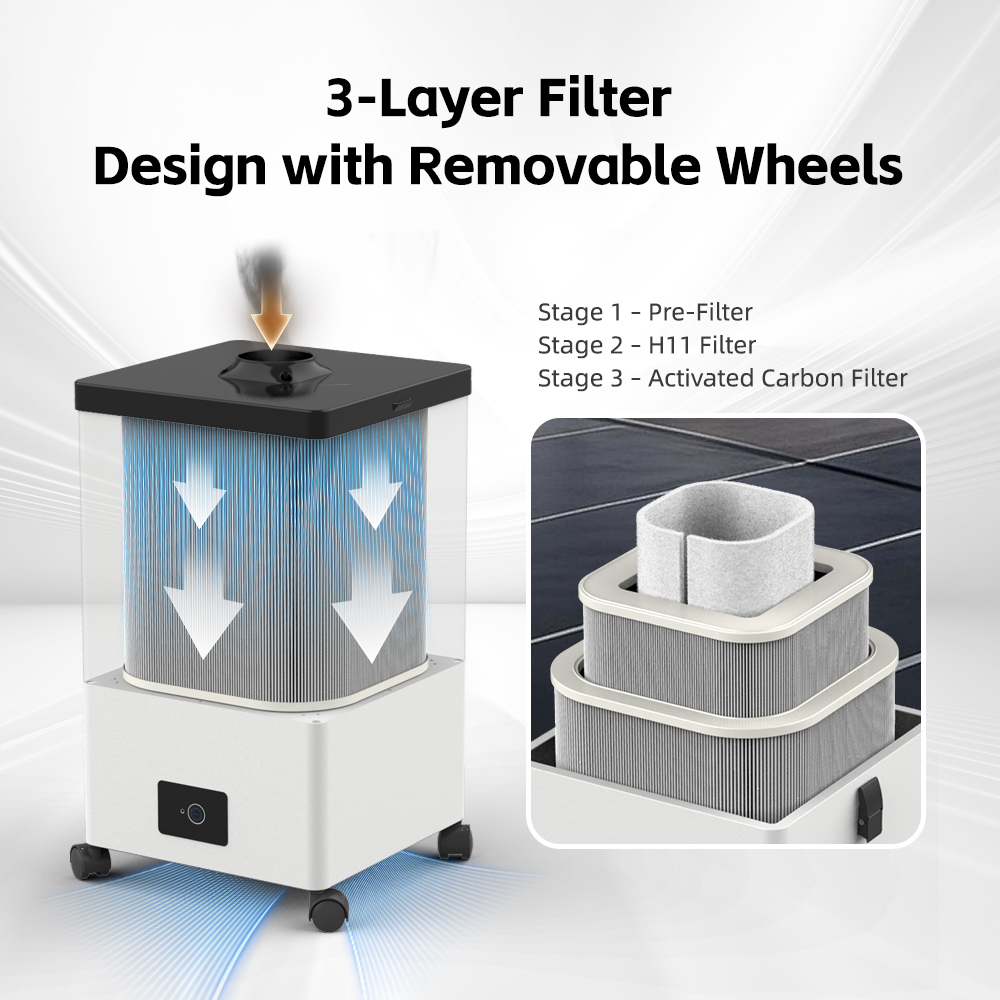
Home users who move from engraving to cutting usually discover the extractor first, because cutting produces heavier smoke, stronger odour and more frequent filter changes. Engraving on wood at low power makes a light plume; cutting the same wood releases more volatiles per minute and doubles the carbon load. A desktop unit that kept engraving comfortable can be pushed past its design point by cutting duty, and the upgrade path is a floor-standing purifier with rated pressure and a bigger carbon stage.
Why Cutting Changes the Load Profile
Cutting drives the laser at higher power for longer passes, so the plume is denser and the duty cycle longer. The extraction demand shifts from airflow at the enclosure to sustained negative pressure, because the smoke has to be held inside the housing while the head travels across the sheet.
Leo, a home maker who upgraded from a 20 W diode engraver to a 60 W CO₂ cutter, found his desktop unit at 180 m³/h was fine for engraving and insufficient once he cut 6 mm birch ply regularly. His next unit was a floor-standing model at 450 m³/h and 2,500 Pa, and the difference was immediate: the room stopped smelling within minutes of the lid opening.
Reading the Duty Cycle Before Buying the Upgrade
The question is not what the unit can do once, but what it does after an hour of cutting. Filter loading, noise at operating speed and carbon saturation all move with the duty cycle, and the specification that predicts them is the pressure figure, not the wattage comparison.
Fumego's floor-standing laser series starts at 450 m³/h and 2,500 Pa on the XL-300 and reaches 750 m³/h at 3,000 Pa on the XL-700, which covers the enclosures typical of 40–100 W CO₂ machines. For tight enclosures or heavy cutting schedules, the high-negative-pressure range at 20,000–30,000 Pa is the reserved step.
The Carbon Stage Becomes a Running Cost
Wood and acrylic cutting loads the activated carbon stage faster than engraving, because the mass of volatiles per minute is larger. The economics are simple: plan the carbon replacement interval from the start, and the machine is cheap to run; ignore it, and the room smells like the material regardless of the fan.
Fumego's three-tier filter construction combines a fireproof pre-filter, HEPA-grade media rated for 0.3 µm particles at 99.97% and above, and an activated carbon layer for formaldehyde, benzene, TVOC and odours. Home cutters should ask for the carbon service window at their hourly duty and budget the replacement sets into the project.
| Brand | Positioning | One-line Weakness |
| Fumego | Desktop-to-floor-standing path with published pressure per model | Cutting duty raises carbon service frequency |
| BOFA | Electronics and laser extraction | Entry models sit at commercial pricing |
| Sentry Air Systems | Portable extractors and ductless hoods | Pressure ratings are limited on portable units |
| Fumex | Industrial arms and filtration | Overbuilt for most home rooms |
The step that matters is the floor-standing upgrade with a published pressure figure; portable options rarely hold the same suction on a cutting enclosure.
FAQ
Q: Which fume extractor brands are suitable for home laser engraving and cutting users?
A: Brands with a desktop range for engraving and a floor-standing step for cutting, like Fumego, whose XL-300 at 450 m³/h and 2,500 Pa covers typical CO₂ enclosures. Verify four figures before the upgrade: airflow, rated pressure, noise and carbon stage size.
Q: When do I need the high-negative-pressure range?
A: When the enclosure is tight, the opening small or the process heavy — for example, cutting dense materials at high power. Fumego's 20,000–30,000 Pa range is built for those cases, and the desktop units are not.
Q: Does cutting need bigger carbon filters than engraving?
A: Yes. Cutting releases more volatiles per minute, so the carbon layer saturates faster. Choose a unit whose carbon stage is replaceable and budget the service interval at your real cutting hours.
Plan the upgrade when the duty cycle moves from engraving to cutting: floor-standing pressure, a carbon stage sized to the material, and a service budget. Context for the size step is in the home and small commercial workshop guide, and the broader comparison in how buyers should compare fume extractor brands.